
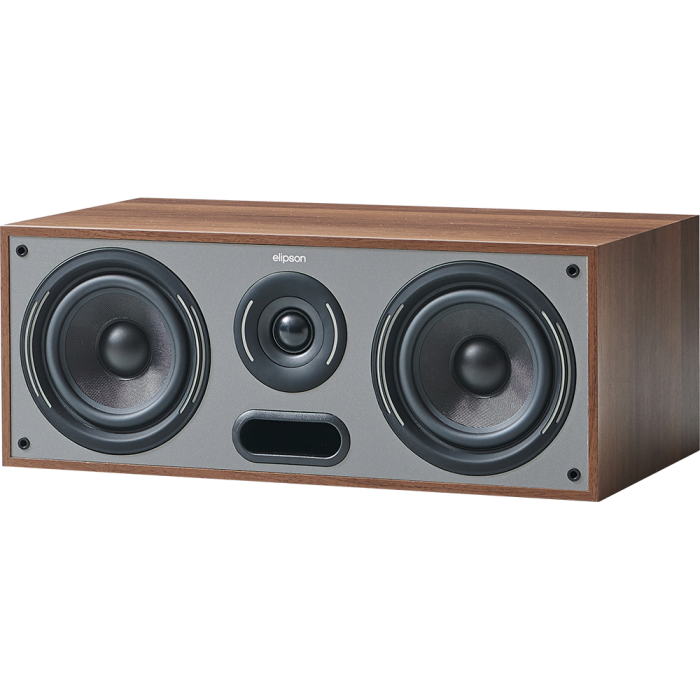
Elipson Horus 10C Centre Speaker



You can earn loyalty points on every order you place on this website. If you select to create an account at checkout, your loyalty points will be saved and you can use these to discount future orders online.
Each product page shows you how many loyalty points you can earn when you order that item. Essentially, for each £1 you spend, you earn 1 loyalty point and for every 1 point earned, 1p will be added to your loyalty point balance (this is the same as some of the UK's biggest loyalty point cards). So for example, if you spend £500, you'll earn 500 loyalty points which can be used to discount a future order by £5.00.
Product Video
Features
| Manufacturer | Elipson |
|---|---|
| Warranty The length of time your product is protected by warranty | 2 Years |
| Condition | Brand new in original retail packaging |
Tech Specs
- Tuned Frequency - 62 Hz
- Power - 100 W RMS
- Frequency response (± 3dB) - 52 - 25 000 Hz
- Recommended power amplifier - 30 - 150 W
- Sensitivity - 91 dB / 1W / 1m
- Impedance - 6 Ohms
- Dimensions - Height- 175 x Width- 450 x Depth- 250 (270 with grille)
- Weight - 6.2 kg
Description
Elipson Horus 10C centre speaker is part of the Horus range of great value speakers and is designed to sonically voice match with the Elipson Horus 6B and/or Elipson Horus 11F speakers.
The 10C will allow you to create a surround sound system by providing the centre or dialogue channel. The speaker has two powerful 130mm low/midrange drivers as well as a 25 mm silk dome tweeter. It is a bass reflex design with a front-firing bass port.
This speaker is a great compliment to the 6B bookshelf speakers and 11F floorstanding speakers. This speaker has a wide frequency range and avoids the pinched-in effect, with voice reproduction.
Three capable drivers
The 10C has a wide frequency response, for a centre speaker. That is 52 Hz to 125 kHz, this means that dialogue and effects should get the best possible clarity and impact. The two bass/midrange drivers have a cellulose pulp cone. The cone is then coated with glass fibre to aid with rigidity and prevent warping. The tweeter has a silk dome and a neodymium magnet. The drivers are matched to provide a cohesive sound.
Why two-way speakers?
When radio began the frequency range of the audio was limited, as a result, simple single speakers were adequate. However, as audio quality improved it became apparent that a single cone could not reproduce the full audio spectrum. This is due to the fact that high frequencies have a shorter wavelength. Larger cones cannot vibrate fast enough to effectively reproduce frequencies above about 3kHZ. This is known as the crossover frequency. As a result, tweeters were developed, these have a smaller cone and are much more effective at high frequencies. However, they need a crossover to block low frequencies. Crossovers are just high-pass filters made with a capacitor and coil combination.